No revision limit in my quotes, and I still never go past three rounds
Personally, I don’t charge extra for revision rounds, and I’ve never gone beyond three rounds so far; usually, a track is approved and paid for after the second or third round.
I mention this because you constantly read on studio blogs that the base price should cover two, or at most three, rounds, with any additional ones costing extra. A feedback software provider recently described it this way: unlimited revisions eat into your profit margins.
Someone mixing for dozens of clients a month might need a rule like that. But simply stating a number in the quote doesn’t solve the underlying problem; it just puts a price on it.
In my opinion, when a project spirals out of control, it’s rarely because of the mix itself. Either the client’s vision wasn’t clearly communicated from the start, or the client wasn’t even sure what they wanted themselves. You end up tweaking details round after round, even though the fundamental question was never resolved at the beginning.
That’s why I establish a clear direction with every artist beforehand, so no one ends up disappointed later on. This requires the most effort with beginners. They often don’t fully understand what they want yet, and that’s exactly where you have to be persistent as a producer, even if it feels a bit like assigning homework. I ask for reference mixes or arrangements that we can use as a guide. A reference agreed upon before the first version is created is the point you come back to when perceptions start to shift.
Feedback without the guesswork
In the past, like everyone else, I used to get feedback via WhatsApp or Telegram. It was often phrased so vaguely that, as a producer, I had to guess which part of the song or which instrument was actually being discussed.
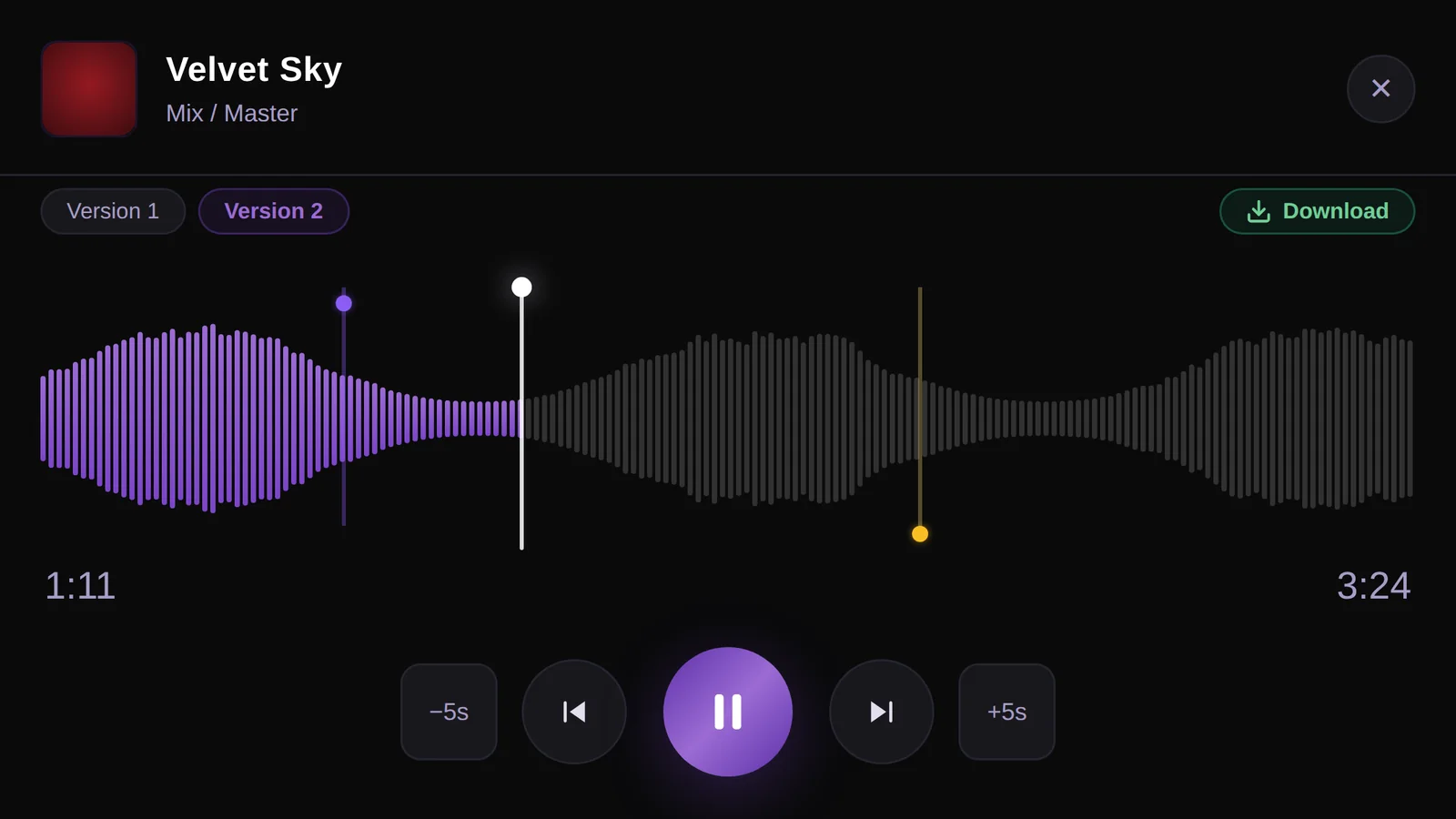
Things have become much simpler since my artists started using CuePort to give feedback, as comments are placed directly on the relevant section of the waveform. That said, it’s not entirely without friction. Some artists still find it a bit of a hassle to go into the player specifically to write comments at certain points. However, my impression is that this actually makes them listen more closely, and the comments themselves are less generic.
For me, less guesswork means fewer rounds of revisions.
When it’s no longer a revision
I don’t have a hard-and-fast limit. However, there is one scenario I treat differently: when a track has already been approved, but the artist suddenly wants a different instrumental. That is no longer a revision.
A revision means working on what we’ve already agreed on; a new instrumental is a new idea.
How do you handle it? Do you put a number in your quotes, and have you ever actually exceeded it?
Frequently asked questions
How many revisions are standard for a mix?
Many studios include two or three rounds of revisions in their base price and charge extra for any additional ones. In practice, a track is often approved after two or three rounds if the intended direction was clear from the start.
Should I offer unlimited revisions as a producer?
It depends less on the number and more on preparation. If you establish the direction and references with the artist before the first version, you can usually manage without a fixed limit; a set number in the quote makes more sense when dealing with a lot of new or unknown clients.
Why do some projects require so many rounds of revisions?
Usually, it’s because the client’s requirements weren’t clearly defined beforehand, or the client hadn’t made up their mind yet. Especially with up-and-coming artists, asking for reference mixes or arrangements before starting helps a lot.
Does a new instrumental count as a revision after approval?
No, a new instrumental after approval is essentially a new job. A revision improves the agreed-upon version, whereas a different instrumental is a new idea.
How can I get more precise feedback from artists?
The best approach is to gather feedback directly at the specific point in the track, rather than through messenger chats. When comments are attached to a specific point in the waveform, they become more concrete, and the producer doesn't have to guess what is meant.