Who made this? The music business wants receipts now
Contents
On August 20, Apple Music told its labels and distributors that disclosing AI at upload is becoming mandatory. It reads like a footnote from a metadata spec, but the four weeks that followed brought so much pointing the same way that I no longer see it as a one-off. The industry has stopped taking uploads at face value. It wants to know who made the music, and when in doubt, it wants you to be able to show it. Here's the month, current as of September 23, 2026.
Three platforms, three ways of asking
Apple calls the fields AI Transparency Tags. They arrived in March as optional metadata, split into recording, composition, artwork and music video, and going forward labels and distributors are supposed to set them whenever AI created a "material portion." Apple hasn't named a start date, and the public spec still lists the field as optional. Later this year, listeners are supposed to see a "Made With AI" label (Complex, via Yahoo). Apple hasn't said where "material" starts, though, and it doesn't detect anything itself. So the call gets made by whoever fills in the metadata, which is your distributor, which means they're going to ask you.
Australia goes further. Starting with the ARIA chart dated August 31, a recording made with generative AI can only chart if it's "substantially human made" and raises no red flags for stream manipulation. Fully AI tracks are out, retroactively if needed, and ARIA can even ask for a No. 1 award back (ARIA). Artists can contest an exclusion by providing evidence.
"Trust me" won't cut it.
The line between the two comes from a labeling standard that IFPI, the RIAA, A2IM and others put out in July. "AI-Generated" means AI produced the core creative elements, like the lead vocal or the main instrumental performance, and "AI-Assisted" means humans stay primarily responsible.
Spotify looks at the person rather than the music. Since mid-September, the mobile app has been rolling out an "AI Persona" badge for artist profiles whose public identity is a photorealistic AI-generated person, either because the artist disclosed it or because Spotify reviewed the profile, in which case it reads "Likely AI Persona" (Spotify Support). If you use AI in production but you're a real person on your profile, you won't get one. For flagged profiles the consequence is harsh anyway, because their music drops out of editorial and algorithmic recommendations unless a listener actively engages, for example by following them.
Suno signs up with the labels
On September 9, Suno launched its v6 models, built with Warner Music, BMG and Believe, and retired every older model the same day. Monthly download caps have applied since September 3, and Suno has committed to audio watermarking (Music Business Worldwide). The bigger twist landed a day earlier. Back in April, Believe, which owns TuneCore, started blocking Suno tracks from distribution. Now the two have a global partnership, and songs made with the new licensed model can go out through Believe and TuneCore (MBW).
So the dividing line isn't AI versus no AI anymore. It's licensed tools versus unlicensed ones.
Universal answered on September 10 with ElevenLabs instead, signing a multi-year license for a platform where fans can remix and mash up tracks from artists who opt in. There's no launch date yet (UMG).
And who actually gets paid? Nobody's saying. On September 21, the Los Angeles Times pointed out that none of the companies involved have disclosed what artists will earn or how many have opted in (LA Times, via Yahoo).
Until that changes, I wouldn't read "licensed" as "fair."
Why now?
Look at what Deezer published in July. On peak days in June, more than half of all new uploads there were fully AI-generated, roughly 90,000 tracks a day, and together they make up just 1 to 3 percent of streams. Up to 85 percent of those streams in 2025 were fraudulent (Deezer Newsroom).
Deezer says the main purpose of these uploads is fraud, meaning draining the same royalty pool you get paid from. It strips those streams out, and says the impact on human artists on its own platform is minimal as a result.
That's what the Streaming Integrity Initiative is aimed at. IFPI launched it on September 14, and its supporters include all three majors plus Merlin, IMPALA, CD Baby, Ditto, FUGA, RouteNote and The Orchard. Participating distributors commit to verifying customer identity and rights, vetting uploads for fraud and AI-related risks, acting against repeat offenders and sharing intel so bad actors can't just hop to the next service (IFPI).
The legal side is pulling two ways. In Germany, the Munich Regional Court ruled largely in GEMA's favor against Suno at the end of July, though the ruling isn't final yet, and we covered the details in a separate post. In the US, the Justice Department weighed in on September 1 in the New York Times' lawsuit against OpenAI, arguing that training a language model on copyrighted text is fair use (Music Business Worldwide). That's a statement of interest, not a ruling, and it's explicitly about text rather than recordings, but a judge weighing the Suno or Udio cases can still read it.
Whether training is legal won't be settled anytime soon. What's allowed onto the platforms is being decided right now.
What I'd take into the studio
If you make music by hand, this is good news to start with, because the platforms are beginning to tell your work apart from a flood that eats into your reach and your royalties. Almost all of it runs on self-reporting, though. Apple doesn't check, ARIA wants evidence if there's a dispute, and your distributor asks at upload.
And where does "AI-Assisted" actually end?
An AI assistant suggesting a vocal chain isn't the same as a generated guitar riff the whole song is built on, and both can happen in the same session. So I'd start keeping track of a few things while you work, not after the fact:
- which AI tools you used and for what, from stem separation and generated samples to AI mastering and voice cloning
- who played and sang what, and who wrote the lyrics
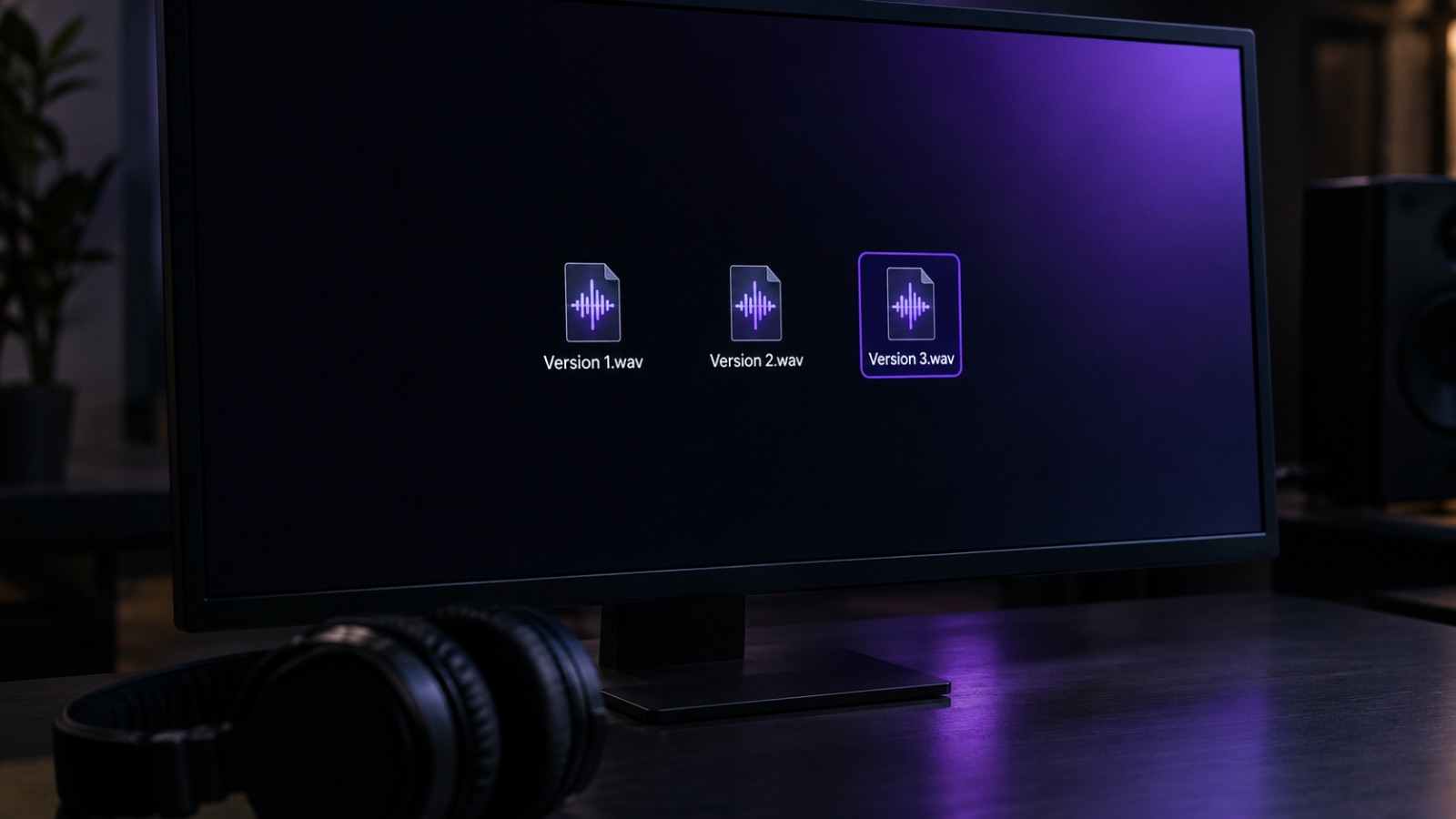
- dated bounces along the way that show how the song grew
- the terms of service for every AI tool in your chain
People sleep on that last one. Suno's terms, for example, give the company a perpetual, irrevocable license to everything you upload and generate, while stating plainly that it makes no promise any copyright will exist in the output at all (per MBW).
You want to know that before a generated loop ends up in a client's chorus.
Nobody can tell you yet exactly what an ARIA appeal requires or how a distributor will check a disclosure, since these processes are brand new. But "how was this track made?" isn't going away, and if you can answer it in a minute, you're in better shape than someone digging through three hard drives and two chat threads.
Full disclosure
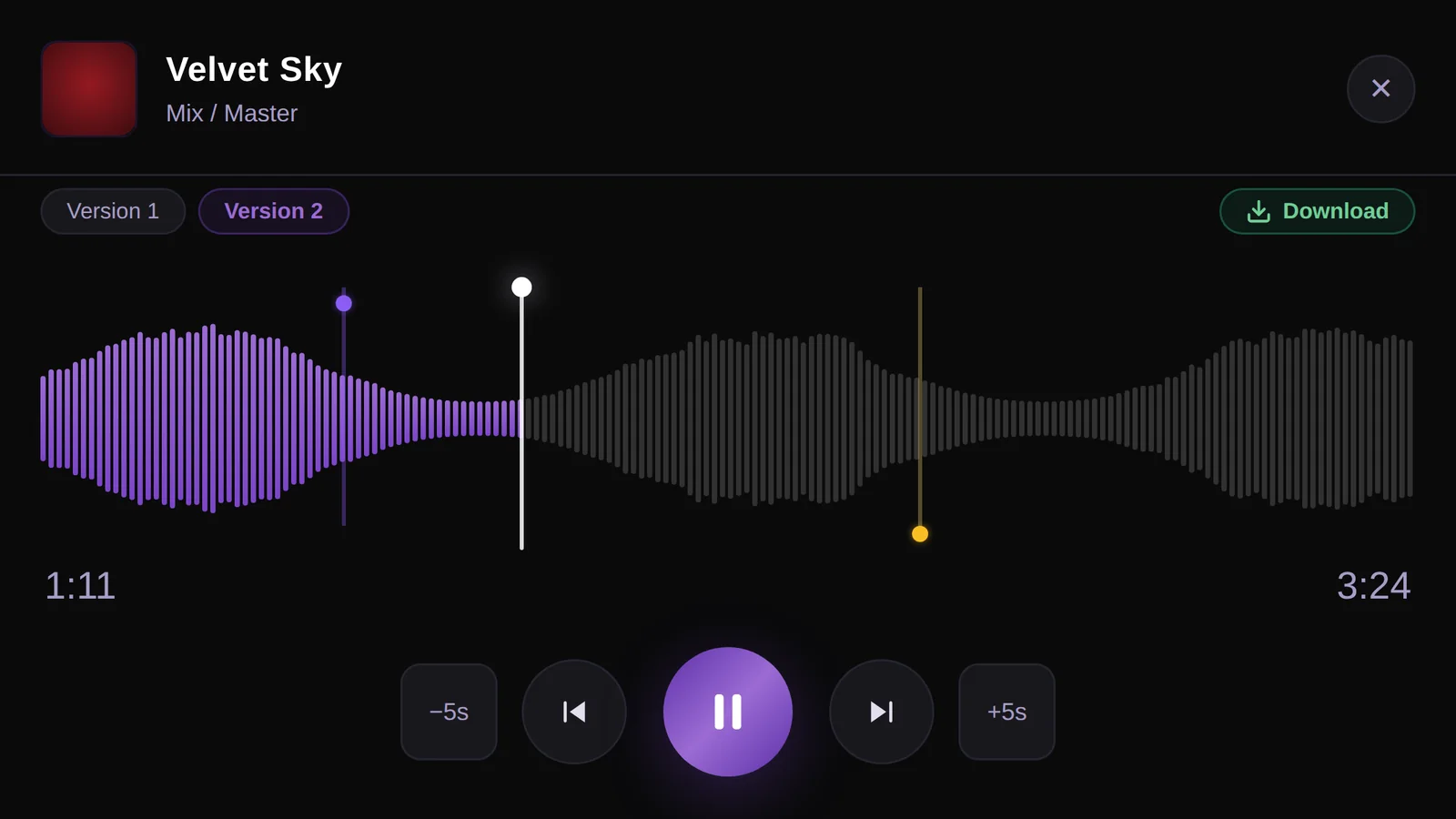
We build CuePort, a platform for studios and producers, and part of it fits this topic pretty closely. Every production is split into steps, from lyrics through instrumental and vocals to mix and master, and every uploaded version is saved with its date, along with the comments on the waveform. That's not legal proof and we don't claim it is. But when a distributor asks how a song came together, you've got the whole path in one place.
Frequently asked questions
Do I have to disclose AI use on every release now?
Apple Music announced in August that labels and distributors will have to flag when AI created a material portion of a recording, composition, artwork or video. No start date has been set yet. Your distributor will ask you for that information, and you should answer truthfully even though Apple doesn't verify it itself.
Will my Spotify profile get an AI badge if I use AI plugins?
No, the AI Persona badge only applies to profiles whose public identity is a photorealistic AI-generated person. If you appear as a real person, under a stage name or as an obviously fictional character, it doesn't apply, even if AI tools are part of your production process.
What's the difference between AI-Generated and AI-Assisted?
Under the industry labeling standard from July, AI-Generated means generative AI created all or most of the core creative elements, such as the lead vocal or main instrumental performance. AI-Assisted means humans remain primarily responsible and AI only contributes some elements.
Can I release Suno tracks through TuneCore now?
Under the partnership announced on September 8, that only applies to tracks made with Suno's new licensed model, not material from its older models. Check the current terms from both Suno and your distributor first, because they've been changing fast.
What should I document to show a track was made by humans?
The most useful thing is a dated trail of the production: early bounces, project files, recordings of the actual performances and a note of which tool was used for which part. That's easy to capture while you work and very hard to reconstruct later.